Air Duct Cleaning Benefits: What Does It Actually Do?
The Short Answer
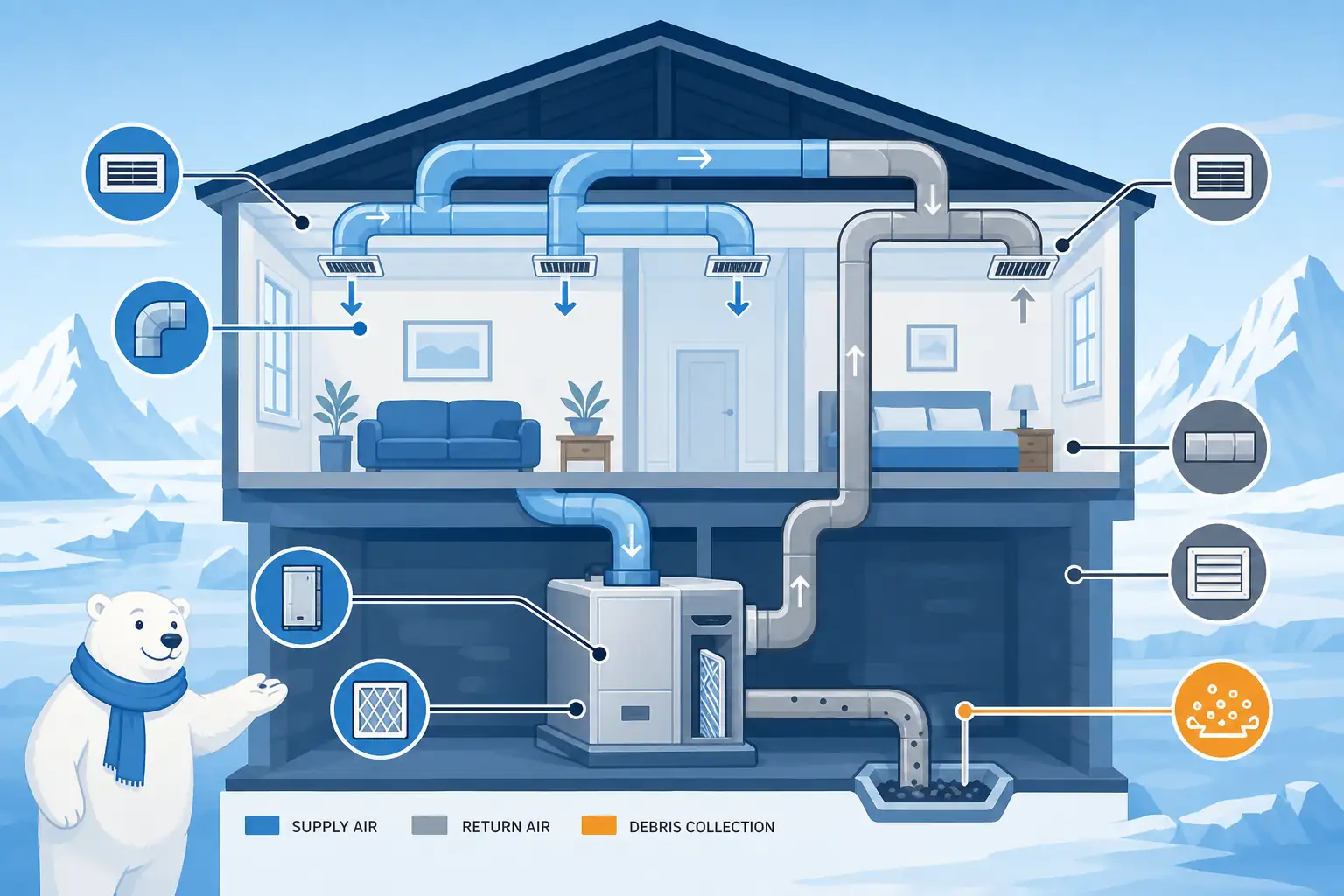
Air duct cleaning physically removes built-up dust, lint, pet dander, renovation debris, and other loose material from accessible supply ducts, return ducts, registers, grilles, and related HVAC components. The real air duct cleaning benefits are practical: cleaner duct interiors, less debris sitting in the system, odor-source removal when the source is in accessible ductwork, and a clearer view of HVAC problems. It does not cure allergies or fix broken equipment.
Air duct cleaning physically removes built-up dust, lint, pet dander, renovation debris, and other loose material from accessible supply ducts, return ducts, registers, grilles, and related HVAC components. The real air duct cleaning benefits are practical: cleaner duct interiors, less debris sitting in the system, odor-source removal when the source is in accessible ductwork, and a clearer view of HVAC problems. It does not cure allergies or fix broken equipment.
A good air duct cleaning visit should show what was cleaned, how it was cleaned, and what problems still need a different fix.
What does air duct cleaning actually do inside the HVAC system?
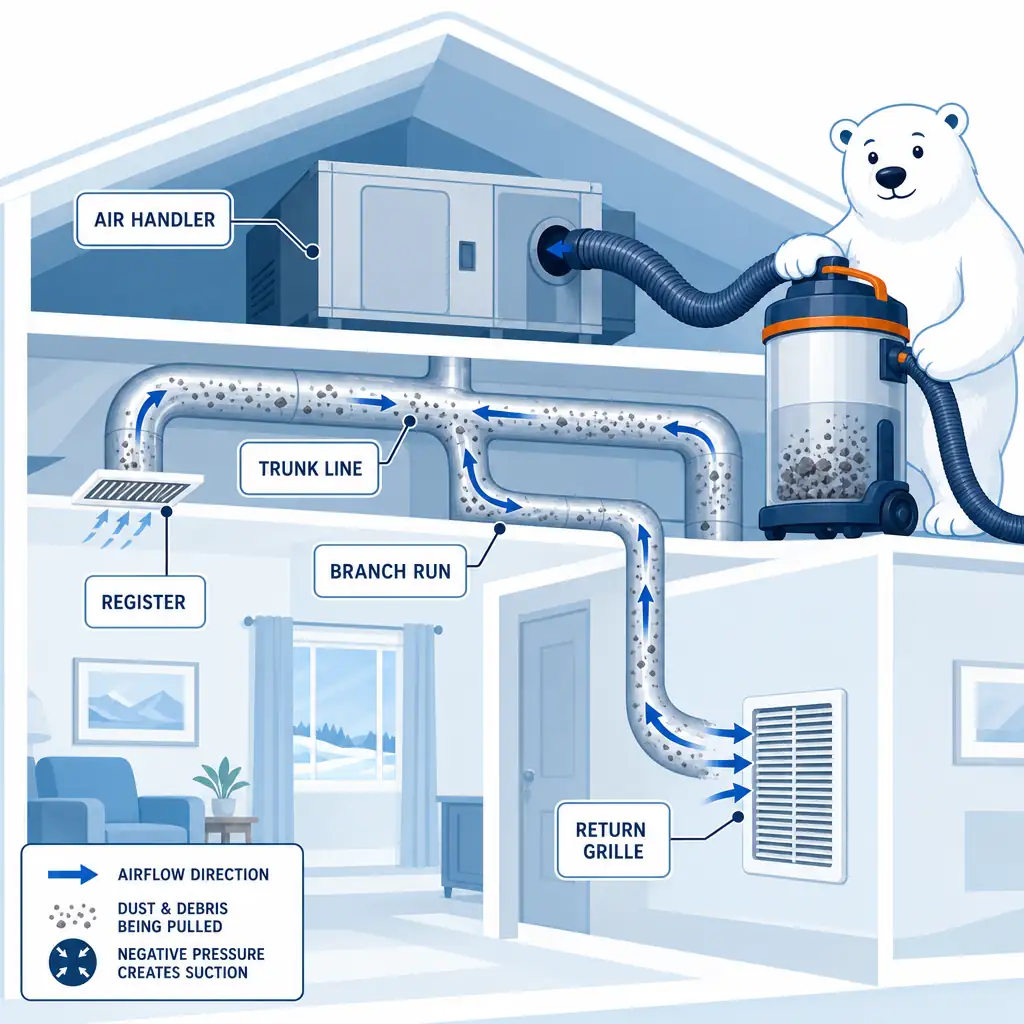
Air duct cleaning removes loose dust, lint, pet dander, construction debris, and other buildup from accessible supply ducts, return ducts, supply registers, return grilles, branch runs, and trunk lines. The goal is source removal, which means getting debris out of the system instead of spraying fragrance or pushing dust deeper into the ductwork.
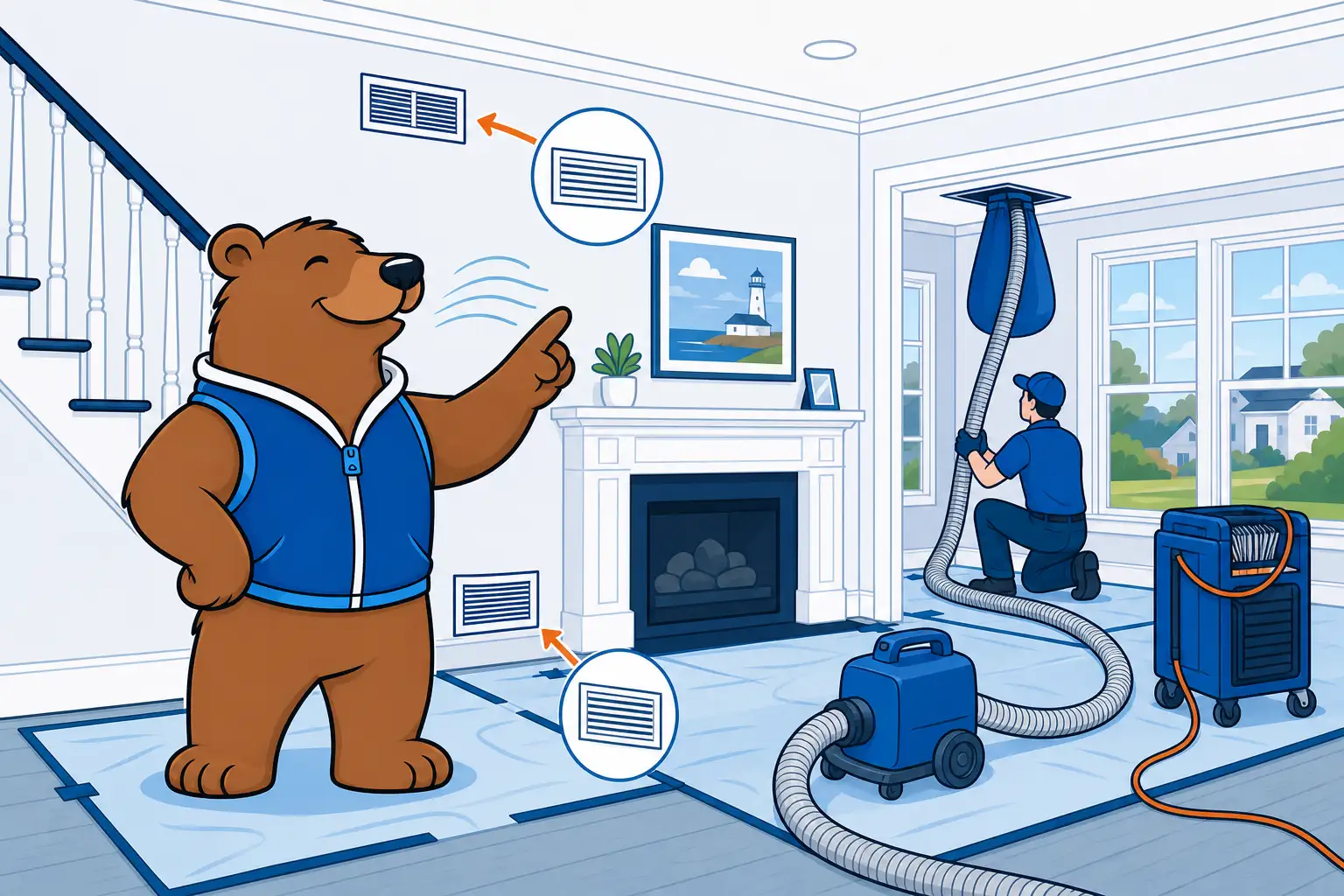
A proper setup uses negative pressure so loosened debris moves toward a collection unit. Depending on the duct material and access, our technicians use a negative air machine, HEPA vacuum, compressed-air tools, a rotary brush, or contact vacuuming.
The cleaning should include both the supply side and the return side. Return ducts often hold more visible dust because they pull room air back to the air handler, furnace, heat pump, or central air conditioning system.
We also look at nearby HVAC components, including the air handler, blower compartment, visible evaporator coil access, filter slot, and cabinet condition. If the blower wheel or coil is dirty, duct cleaning alone does not solve the issue because coil cleaning and HVAC maintenance are separate services.
Good duct cleaning does not seal leaks, resize undersized ducts, replace a dirty MERV filter, or repair failing equipment. It removes what can be reached and safely dislodged from the duct system.
What are the real air duct cleaning benefits?
The real benefits are practical, not magical: less debris sitting inside the duct system, cleaner registers and grilles, odor-source removal when the source is in accessible ductwork, and better visibility into hidden HVAC problems. We do not present duct cleaning as a cure for allergies, asthma, or illness. The EPA guidance on duct cleaning supports cleaning based on visible conditions, not a fixed timer.
Here is the honest way to think about common claims:
| Claim homeowners hear | What we can honestly say |
|---|---|
| It will make the whole home dust-free | No. We remove duct debris, but dust also comes from people, pets, fabrics, windows, gaps, and outdoor pollen. |
| It improves indoor air quality | We remove a contamination source inside ductwork when that source is present. It is not a guaranteed whole-home indoor air quality fix. |
| It helps allergies | We do not promise allergy relief. Pulling that debris out means your system stops recirculating it, so your home holds less duct-fed dust, period. The one thing we never promise is medical outcomes, and no honest duct cleaner should. |
| It removes odors | If the odor source is in accessible ductwork or a return cavity, we remove that source. If the odor comes from moisture, pests, mold, or equipment, the source must be fixed. |
| It improves airflow | Clean ducts move more air when buildup is blocking the duct path. If the problem is a leak, dirty coil, bad design, or weak equipment, that needs a different repair. |
The biggest value is verification. After cleaning, you should have a clearer idea of whether the dust was inside the ducts, at the filter slot, around return grilles, in the air handler, or coming from another part of the home.
When does duct cleaning make sense for a Long Island home?
Duct cleaning makes sense when inspection shows visible debris, contamination, heavy return buildup, pest evidence, post-renovation dust, or odor sources in accessible ductwork. On Long Island, we see these conditions in older ranches, Capes, finished basements, attic air handler setups, and homes where returns have not been opened or checked for years.
Nassau County and Suffolk County homes vary a lot. A North Shore home in Oyster Bay or Huntington may have older sheet metal ductwork with multiple renovation phases. A South Shore home in Babylon, Islip, or Brookhaven may deal with salt-air humidity, crawlspace ductwork, or beach-season sand and pollen getting tracked indoors.
In Hempstead, Valley Stream, Baldwin, and similar neighborhoods, we often see finished basements where returns were moved or boxed in during remodeling. If that work left drywall dust, sawdust, or disconnected return paths, cleaning removes accessible debris, but duct repairs may also be needed.
Duct cleaning is also worth considering after:
- Home renovation dust from sanding, flooring, sheetrock, or kitchen work
- A long period without filter changes
- Pet dander buildup around return grilles
- Visible debris blowing from supply registers
- A musty smell that seems strongest when the HVAC system starts
- A home purchase where the duct history is unknown
- Pest activity that has already been handled by a qualified pest professional
Long Island pollen can make people blame the ductwork, especially during spring and fall. Sometimes the bigger fix is better filtration, a sealed filter rack, less window intrusion, or HVAC service. That is why we prefer inspection first.
What will air duct cleaning not fix?
Air duct cleaning will not fix leaky ducts, poor filtration, undersized ductwork, dirty coils, active mold growth, pest infestations, asbestos concerns, bad insulation, humidity problems, or failing HVAC equipment. If dust, smells, comfort issues, or weak airflow come from those causes, cleaning the ducts leaves the real problem untouched.
Here are common problems that need a different plan:
- Leaky return ducts: A return leak pulls attic, basement, crawlspace, or wall-cavity dust into the system.
- Bad filtration: A loose filter, missing filter cover, or wrong filter size keeps feeding debris into the air handler.
- Dirty evaporator coil: A clogged coil reduces airflow and creates odor or comfort complaints.
- Blower compartment buildup: A dirty blower moves dust even after ducts are cleaned.
- Active mold: Visible mold needs moisture correction and possible mold remediation, not just duct cleaning.
- Pest issues: Droppings or nesting require pest control and sanitation planning before or along with cleaning.
- Asbestos-containing duct insulation: Suspected asbestos should not be disturbed until it is evaluated by a qualified professional.
- Damaged flex duct: Crushed or torn flex duct needs repair or replacement.
- Fiberglass duct board concerns: This material must be cleaned carefully, and damaged surfaces are not good candidates for aggressive brushing.
Comfort complaints are especially tricky. If one bedroom is too hot or too cold, the cause may be duct design, dampers, insulation, equipment sizing, or a weak blower. Cleaning removes debris, but it cannot redesign the system.
What should be included in a standard air duct cleaning appointment?
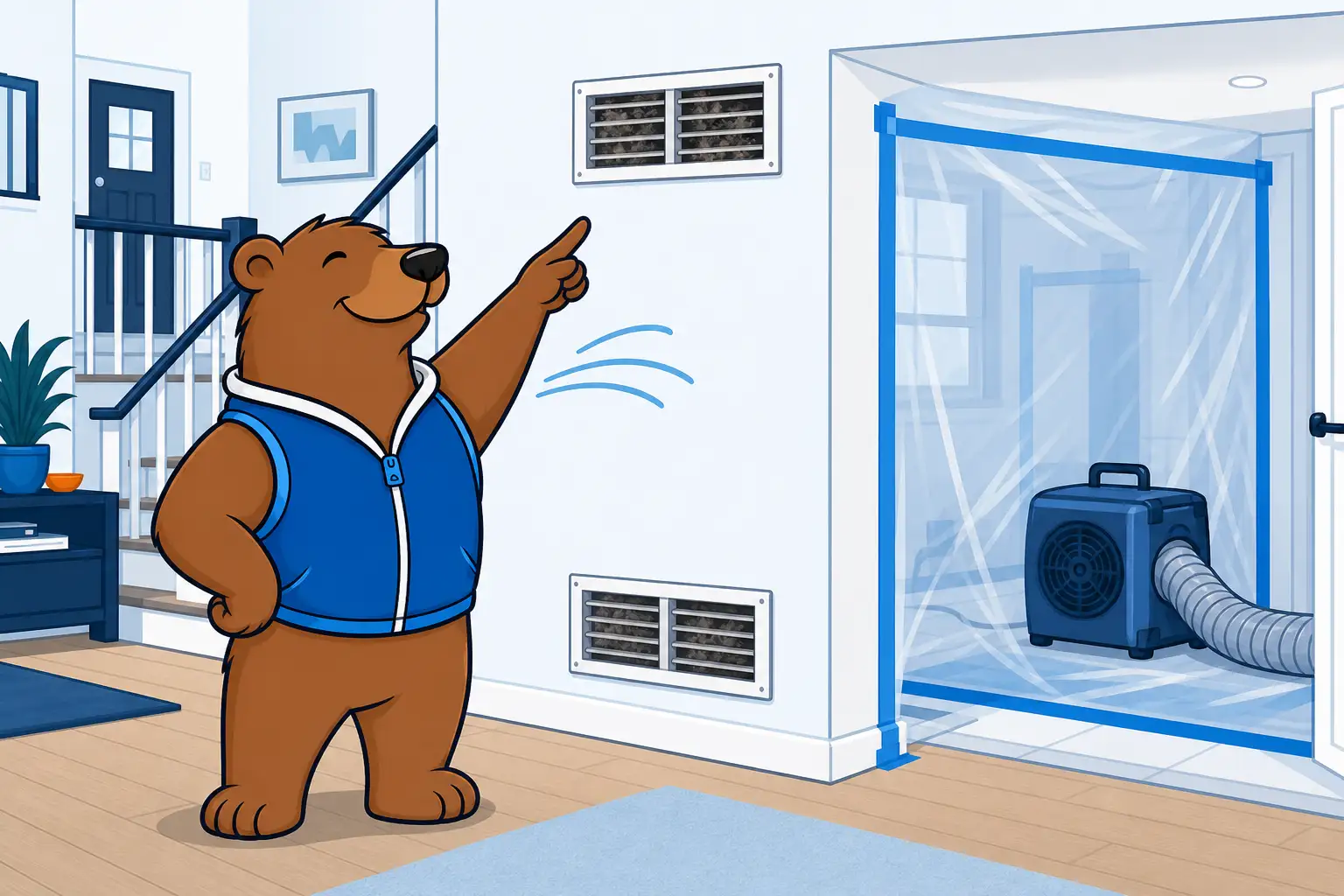
A standard appointment should include an inspection, explanation of scope, register and grille access, negative pressure setup, agitation of accessible supply and return runs, trunk line cleaning where reachable, cleanup around work areas, and before-and-after documentation. The crew should explain what is included before work starts and flag anything outside the basic scope.
A homeowner-friendly checklist should look like this:
- System walkthrough: We identify the furnace, heat pump, central air conditioning equipment, air handler, supply registers, return grilles, accessible trunk lines, and filter location.
- Condition check: We look for loose debris, heavy buildup, disconnected sections, moisture clues, pest evidence, damaged flex duct, fiberglass duct board, and sheet metal ductwork access.
- Scope confirmation: We confirm which HVAC system or systems are included, what the advertised special covers, and what would require a written quote.
- Access and protection: Registers and grilles are opened as needed, work areas are kept clean, and floors are protected where practical.
- Negative pressure: The duct system is placed under suction using the appropriate collection equipment.
- Agitation: Compressed-air tools, rotary brush tools, or contact vacuuming are used based on duct type and condition.
- Supply and return cleaning: Branch runs and accessible trunk lines are cleaned from the correct access points.
- Component observations: We note visible air handler, blower compartment, evaporator coil access, and filter issues that may need HVAC service.
- Final cleanup: Registers and return grilles are reinstalled, work areas are cleaned, and the system is returned to normal operation.
- Documentation: We provide practical before-and-after documentation when access allows, using images or notes from your actual system, not stock examples.
If a provider only vacuums the face of the vents, that is not a full source-removal cleaning. Register cleaning is part of the job, but the debris inside return ducts, supply ducts, branch runs, and trunk lines is the real target.
How is duct cleaning different from HVAC maintenance and other services?
Duct cleaning removes debris from the air distribution system, while HVAC maintenance checks and services the equipment that heats, cools, and moves the air. Filter replacement, coil cleaning, dryer vent cleaning, mold remediation, and duct repair are separate tasks. Mixing these services together can make pricing confusing and can create unrealistic expectations.
| Service | Main purpose | What it does not replace |
|---|---|---|
| Duct cleaning | Removes accessible debris from supply ducts, return ducts, grilles, registers, and trunk lines | HVAC tune-up, leak repair, mold remediation |
| HVAC maintenance | Checks equipment operation, safety, refrigerant-related performance where applicable, belts, motors, burners, drains, and controls | Source removal inside ductwork |
| Filter replacement | Captures airborne particles before they enter the equipment | Cleaning old debris already sitting in ducts |
| Coil cleaning | Cleans the evaporator coil or condenser coil when dirty | Cleaning duct interiors |
| Mold remediation | Corrects moisture and removes or treats mold contamination under the right protocol | Basic duct cleaning |
| Dryer vent cleaning | Clears lint from the dryer exhaust path | HVAC duct cleaning |
Dryer vents deserve special attention because lint buildup is a fire-safety concern. For our dryer vent cleaning, we recommend yearly cleaning for most homes and more often for long runs or heavy use. The NFPA dryer safety guidance tells homeowners to keep the lint filter and dryer exhaust vent clean, so dryer lint is a different issue from HVAC duct dust.
Filter choice also matters. A higher MERV filter is not always better if the HVAC system cannot handle the restriction. Ask your HVAC contractor which filter rating your furnace, heat pump, or central air conditioning system can use safely.
What should you clarify about pricing, specials, quotes, and booking?
Before booking, ask what the advertised special includes, which HVAC system is covered, whether returns are included, what changes the price, and whether you can get a written quote first. A fair process should explain the basic offer, likely add-ons, access limits, and scheduling before our technicians start work.
Our $97 whole-home air duct basic cleaning is the entry-level service. Internal pricing methodology note: these ranges come from our completed whole-home air duct cleaning jobs reviewed in July 2026, with 135 jobs in the review. Based on our completed jobs, most completed whole-home duct cleaning jobs landed between roughly $195 and $650, with a median around $400. Bigger homes, heavy buildup, multiple systems, hard access, or add-ons can push the total higher.
If you want deeper pricing detail for Nassau County, use our Air Duct Cleaning Cost Nassau County Guide instead of trying to compare coupons line by line. It explains why a small ranch, a large colonial, a finished basement system, and an attic air handler can price differently.
Before you schedule, clarify these points:
- Does the current specials price include both supply and return cleaning?
- How many HVAC systems are included?
- Are all supply registers and return grilles included?
- Are trunk lines included where accessible?
- Is blower compartment cleaning included or quoted separately?
- Is deodorizing, sanitizing, or antimicrobial treatment optional?
- What happens if there is mold-like growth, pest debris, or asbestos-containing duct insulation?
- Can we provide a written quote for you to discuss at home first?
We can be reached at 631-900-2634 from 8 AM to 7 PM ET, and you can get a quote or request online booking 24/7. As of July 18, 2026, the latest internal scheduling snapshot available for this article was pulled July 14, 2026. That dispatch snapshot showed most visits were being booked about 4 to 5 days out. In that same snapshot, based on our completed and scheduled service records, 68 of the last 331 service jobs ran same-day or next-day. We use 3-hour arrival windows, and 8:00-11:00 AM was the most requested window.
Appointment length depends on the number of HVAC systems, access, duct condition, and whether the scope changes after inspection. We do not promise one set duration for every home because a small ranch, a large colonial, a finished basement system, and an attic air handler can be very different. Plan for someone to meet our crew at arrival unless another access plan has been confirmed.
How can you tell if a company follows a legitimate cleaning process?
A legitimate company should explain its source-removal method, use negative pressure and agitation tools, clean both supply and return sides, protect the home, document the work, and put the scope in writing. You should also ask about insurance, duct material limits, and whether the company understands NADCA-style standards.
Helpful questions to ask before hiring include:
- Do you clean return ducts as well as supply ducts?
- Do you use a negative air machine, HEPA vacuum, compressed-air tools, rotary brush tools, or contact vacuuming?
- How do you choose tools for flex duct, fiberglass duct board, and sheet metal ductwork?
- Will you show me what was found before doing extra work?
- Can I get a written quote before approving anything beyond the basic cleaning?
- Are you familiar with the National Air Duct Cleaners Association, NADCA, and ACR, The NADCA Standard?
- Can you provide proof of insurance?
- Do you avoid disturbing suspected asbestos-containing duct insulation?
- Do you provide before-and-after documentation from my system?
Be cautious with coupons that sound unlimited but do not define the number of systems, returns, registers, or access points. A low starting price is not automatically bad, but the scope must be clear. The problem is not a special offer; the problem is a special offer that no one explains.
So, is duct cleaning worth it for your home?
Duct cleaning is worth it when inspection shows debris, contamination, renovation dust, heavy return buildup, odor sources, or neglected ductwork that can be safely cleaned. It is usually not worth doing on a timer alone. We recommend inspecting first, cleaning when the conditions support it, and using other services when the ductwork is not the root cause.
Use this simple decision frame:
- Book cleaning now if you see debris blowing from registers, heavy dust inside returns, post-renovation dust, or contamination after a resolved pest issue.
- Ask for a quote first if you have multiple HVAC systems, attic or crawlspace ductwork, a finished basement, old flex duct, or unclear access.
- Call an HVAC contractor if comfort problems point to equipment, coils, duct sizing, insulation, or filtration.
- Call a mold remediation professional if there is active moisture or confirmed mold growth.
- Call an asbestos professional before disturbing suspected asbestos-containing duct insulation.
Long Island homes do not need duct cleaning every year just because the calendar changed. The EPA position is condition-based, and that matches how we work. If the ducts are clean, sealed, dry, and filtered well, we will not tell you to clean them just to sell a job.
What do homeowners ask us before booking?
Homeowners usually want to know what is included, whether the advertised price can change, how soon we can come, and whether they can review a written quote at home. Those are fair questions. A good duct cleaning visit should be easy to understand before anyone opens a register or connects equipment.
What exactly is included in the cleaning?
A standard cleaning includes inspection, register and grille access, negative pressure setup, agitation of accessible supply and return ducts, trunk line cleaning where reachable, cleanup, and documentation. We confirm the exact scope before work starts.
Are there hidden fees on top of the advertised price?
There should not be surprise fees. The price can change when the home has multiple systems, heavy buildup, hard access, or add-ons, but our technicians should explain that before you approve extra work.
Can I get a written quote to discuss at home first?
Yes. If the scope is uncertain or you want to review the cost with someone else, ask for a written quote before approving the job. That is often the best choice for larger homes.
Can I book online instead of talking on the phone?
Yes. You can request online booking 24/7, or you can call 631-900-2634 from 8 AM to 7 PM ET if you want to talk through the scope first.
How far in advance do I need to book on Long Island?
As of July 18, 2026, our latest internal dispatch snapshot for this article was pulled July 14, 2026. It showed most visits were being booked about 4 to 5 days out. Same-day and next-day slots are often available, but the 8:00-11:00 AM window fills fastest.
What should I do before the crew arrives?
Clear access to supply registers, return grilles, the air handler, furnace, heat pump, basement, attic access, or crawlspace entry. Replace or have the right filter ready if needed, and tell us about pets, parking, renovations, odors, or past moisture issues.
Will duct cleaning reduce dust in my house?
We remove the dust and debris sitting inside accessible ducts, registers, grilles, and trunk lines, so the HVAC system stops feeding that old buildup back through the vents. It will not make a home dust-free because people, pets, fabrics, open windows, leaks, and outdoor pollen keep creating new dust.
Frequently Asked Questions
A standard cleaning includes inspection, register and grille access, negative pressure setup, agitation of accessible supply and return ducts, trunk line cleaning where reachable, cleanup, and documentation.
Written by
FreshBear Field TeamField Technicians
The FreshBear field team handles air duct, dryer vent, and chimney cleaning across Long Island, Queens, and Brooklyn. Every guide is based on what our technicians actually see in local homes, reviewed for accuracy before publishing.
Keep Reading
Post Renovation Duct Cleaning Nassau County Guide
Not every renovation needs duct cleaning. Learn when Nassau County homeowners should book, what is included, what costs extra, and when to wait.

Duct Cleaning Before Moving In Long Island Homes: Should You?
Moving into a Long Island home? Here is when duct cleaning is worth doing before furniture arrives, when it can wait, and how to book it without surprises.
Professional Duct Cleaning Process Long Island: What Happens?
A no-surprises walkthrough of what happens during professional duct cleaning in Long Island homes, from booking and written quotes to equipment, cleanup, and verification.