
Roof vs Wall Dryer Vent Long Island Homes: Which Is Better?
The Short Answer
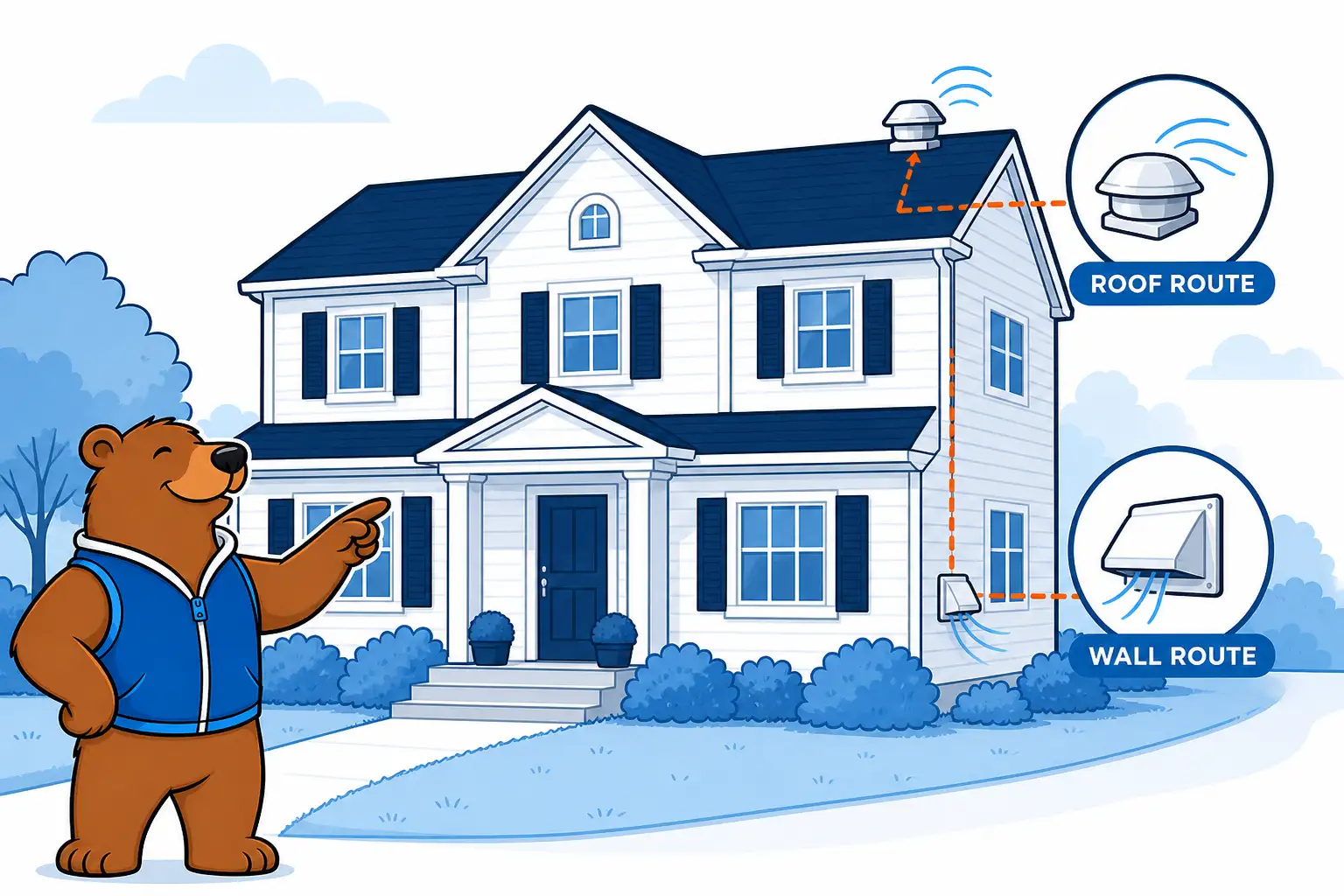
For most Long Island homes, a wall dryer vent is better when it creates the shortest, straightest, safely serviceable route outdoors. A roof dryer vent is still acceptable when the duct is smooth metal, properly terminated, easy to access, and cleaned at least once a year. The best choice is the route that moves lint and moisture out with the fewest restrictions.
The roof vs wall dryer vent Long Island homeowners ask about comes down to route quality, not the exit point alone. A short, straight wall termination hood is usually easier to clean and inspect. A roof termination cap is acceptable when the run is built correctly, stays accessible, and gets cleaned on schedule.
We see both setups across Nassau County and Suffolk County. Levittown-style homes, capes, ranches, split-level homes, colonials, condos and townhomes all create different routing problems. The right answer depends on where the dryer sits, how many elbows the duct needs, how high the exit is, and whether the full run can be cleaned from dryer to termination.
Is a wall dryer vent usually better than a roof dryer vent?
A wall dryer vent is usually better when it gives the dryer the shortest, straightest, safest path outdoors. It keeps the termination low, visible, and easier to service. That means lint problems get spotted sooner, the wall hood is simpler to clean, and repairs are less complicated than roof work.
That does not make every wall vent good. A wall termination hood near a deck, walkway, soffit area, window, or tight side yard needs careful placement. The backdraft damper must open freely, and the exit cannot be blocked by snow, mulch, shrubs, screens, or a lint screen restriction.
A good wall setup uses a 4-inch smooth metal dryer duct, rigid metal duct where possible, and a short semi-rigid metal transition duct behind the dryer. Foil or plastic transition hose is a risk because it crushes, traps lint, and slows airflow. Once lint is gone from a proper wall run, the dryer moves hot, wet air outdoors instead of fighting a packed exhaust path.
For most Long Island homes with basement laundry or garage laundry, a wall exit is the cleanest choice if the dryer backs up to an outside wall. It is also easier for our technicians to inspect during dryer vent cleaning, because both ends are usually reachable without roof equipment.
Roof vs wall dryer vents: what are the practical pros and cons?
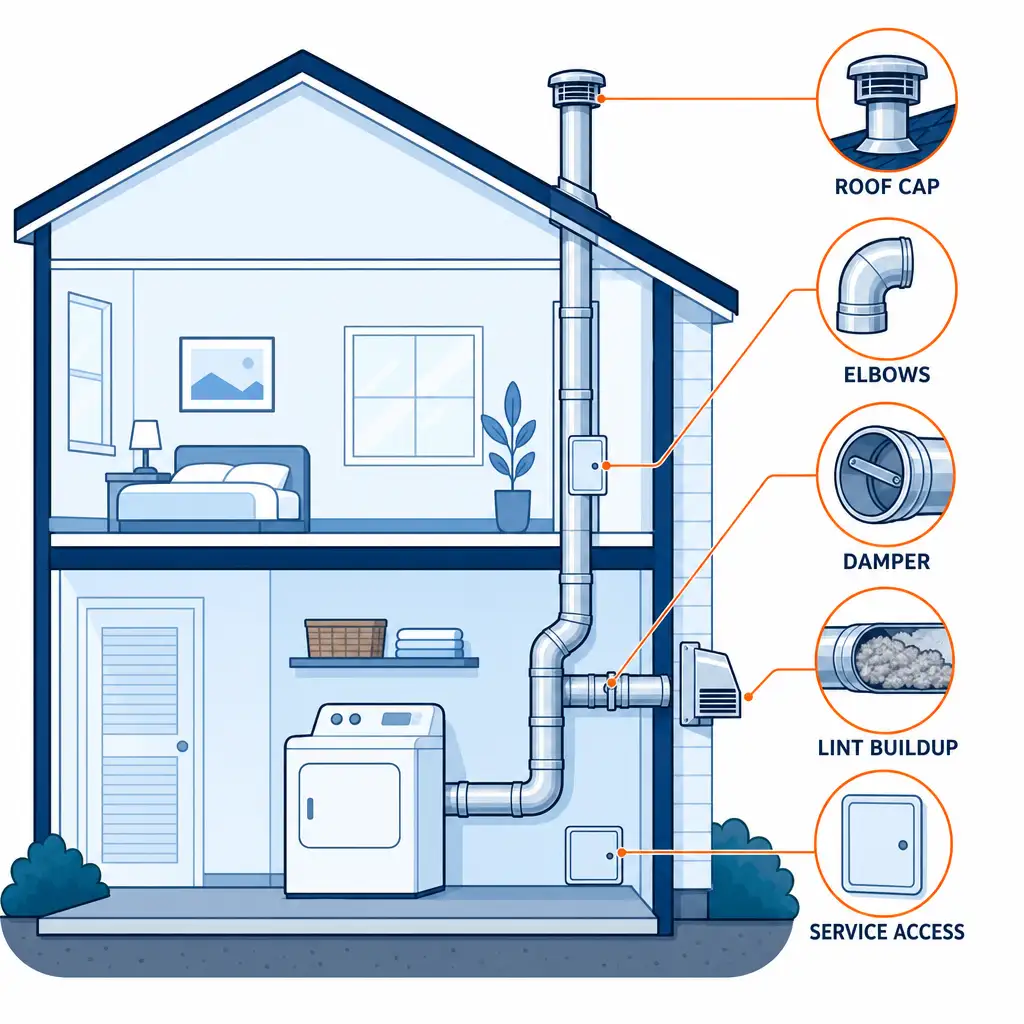
Roof and wall vents both work when the duct route is correct, but they fail in different ways. Wall vents usually win on access and cleaning convenience. Roof vents become more sensitive to vertical duct run length, roof pitch, attic run access, weather, and whether the roof termination cap stays clear.
| Practical factor | Wall termination hood | Roof termination cap |
|---|---|---|
| Best use case | Dryer near an exterior wall, basement laundry, garage laundry, short first-floor run | Interior laundry closet, second-floor laundry, slab layout, addition with no direct wall route |
| Lint buildup pattern | Often collects at elbows, crushed transition hose, or exterior hood | Often collects in vertical duct run, roof cap, bird guard, or damper area |
| Cleaning access | Usually easier from ground level and behind the dryer | Harder when roof pitch, height, weather, or ladder access limits safe access |
| Homeowner visibility | You can often see lint at the hood or damper | You may not see roof cap lint without attic or roof access |
| Weather exposure | Exposed to shrubs, snow, sprinklers, and low exterior obstructions | Exposed to wind, coastal humidity, South Shore salt air, and roofline conditions |
| Repair complexity | Hood replacement is usually simpler | Roof flashing, cap replacement, and leaks need roofer or contractor evaluation |
| Convenience | Easier to monitor between cleanings | Acceptable, but it needs better planning and safer service access |
Which vent type clogs faster? The longer, more twisted, and more vertical one usually clogs faster. In many homes, that means a roof run builds lint sooner because it rises through walls or an attic before reaching the roof. But a bad wall run with too many elbows, a crushed hose, or a blocked exterior hood clogs fast too.
The National Fire Protection Association tells homeowners to clean the lint filter and have the dryer exhaust vent cleaned as part of dryer safety. We follow that annual dryer vent cleaning position, and we recommend more frequent cleaning when a roof run is long, vertical, or heavily used. You can read the NFPA guidance in its clothes dryer safety tip sheet.
Why do so many Long Island homes have roof dryer vents?
Many Long Island roof vents exist because the laundry room moved after the house was built. Additions, finished basements, slab construction, interior laundry closets, and second-floor laundry renovations often leave no clean outside wall nearby. A roof route becomes the installer’s practical way to get exhaust outdoors.
In Nassau County, we often see renovated capes and ranches with patched or extended mechanical runs from older layouts. In the Town of Hempstead, Town of Oyster Bay, and Town of North Hempstead, many Levittown-style homes have been changed several times since the original build. Laundry that started in a basement or utility area may now sit in a hall closet, kitchen-adjacent room, or garage conversion.
In Suffolk County, longer homes and larger lots create different issues. Split-level homes and colonials in the Town of Babylon, Town of Brookhaven, Town of Islip, and Town of Huntington can have laundry rooms far from a simple sidewall exit. A second-floor laundry may route up to the roof because dropping down and across the house would add even more elbows.
Condos and townhomes add another layer. HOA rules, shared walls, and exterior appearance rules may control where a vent can terminate. Before changing a roof termination cap to a wall termination hood, owners should check building rules and local requirements.
What code and safety basics should you know before approving dryer vent work?
Homeowners do not need to memorize code, but they should recognize the big safety points before approving a repair or reroute. Dryer exhaust should use a proper 4-inch metal duct, terminate outdoors with a working damper, avoid screens, limit bends and length, and follow dryer manufacturer installation instructions.
Ask the installer how the proposed route fits the International Residential Code IRC M1502, the New York State Residential Code, and your local authority having jurisdiction. Local enforcement can vary, so a contractor should not wave away code questions with vague answers.
Here are the plain-English items that matter most:
- Use smooth metal dryer duct for the permanent run, not plastic or foil duct inside walls.
- Keep the route as short and straight as the home allows.
- Count elbows, because each turn adds resistance and traps lint.
- Terminate outdoors, not in an attic, crawlspace, garage, soffit area, or wall cavity.
- Use a backdraft damper that opens fully under dryer airflow.
- Avoid screens at the termination, because screens catch lint and choke airflow.
- Confirm clearances around windows, doors, decks, walkways, rooflines, and soffits with the code official or qualified installer.
- Follow the dryer manufacturer installation instructions, especially for maximum duct length and booster fan rules.
Can a dryer vent terminate near a soffit, window, deck, walkway, or roofline? Sometimes the area is workable, and sometimes it is a red flag. The exact answer depends on clearance, air movement, manufacturer instructions, local code, and whether the termination dumps moist lint-laden air where it can damage materials or bother people.
What warning signs show the dryer vent route is not working well?
A failing route announces itself through dry time, heat, lint, moisture, and shutdowns. If a full load takes more than one cycle, the laundry room feels hot, or the dryer cabinet overheats, the exhaust path is not moving air properly. Clean venting restores the path so hot, wet air leaves the house.
With wall vents, look for lint packed around the wall termination hood, a flap that barely opens, staining on siding, or a hood blocked by bushes, snow, mulch, or a deck. Inside, watch for a crushed transition hose behind the dryer. That short hose causes a surprising number of airflow problems because it gets flattened when the machine is pushed back.
With roof vents, warning signs are harder to see. Lint at the roof termination cap, a stuck damper, bird nesting, or a packed bird guard can block discharge. A vertical duct run also holds moisture and lint differently than a short wall run, especially in homes with attic run sections.
Moisture and condensation matter on Long Island. Coastal humidity and South Shore salt air already make damp building materials work harder. A clogged dryer vent adds more warm moisture to the wrong places, which can create musty smells around laundry areas, closets, attic chases, or nearby finishes.
Dryer fire risk is real because lint is fuel. The NFPA tracks home fires involving clothes dryers and washing machines in its dryer and washing machine fire research. Cleaning removes the lint fuel from the exhaust path, so the dryer stops pushing heat through a clogged lint supply.
Should you keep the roof vent or reroute to a wall?
Keep the roof vent when it is built correctly, the duct is smooth metal, the run is not overly long, the roof cap works, and safe cleaning access exists. Consider a wall reroute when the roof path is long, packed repeatedly, unsafe to access, damaged, or routed through poor materials.
Here is the simple decision framework we use with homeowners:
Cleaning is enough when
- The duct is intact and accessible.
- The roof termination cap or wall hood opens properly.
- The dryer dries normally after the lint is removed.
- The issue is normal annual lint buildup.
- No water leak, crushed hidden duct, or unsafe termination appears.
With the lint gone, your dryer dries a full load in one cycle again when the blockage was the cause of slow drying. The dryer also pushes less heat into the laundry room because exhaust air has a clear exit.
A roof cap repair may be enough when
- The roof termination cap is cracked, clogged, or stuck.
- The bird guard is packed with lint.
- The damper does not open freely.
- The flashing or cap looks damaged.
We clean dryer vents, but roof leaks, roof flashing, cap replacement on steep pitches, and roofline repairs may need a roofer or qualified contractor. We tell you when the problem is outside a normal cleaning scope.
A wall reroute is worth discussing when
- The dryer is near an exterior wall.
- The existing roof run has too many elbows.
- The vertical duct run keeps clogging quickly.
- The attic section is inaccessible or damaged.
- The roof pitch or ladder access makes routine service unsafe.
- A booster fan is needed only because the route is too long.
A dryer booster fan is not a cure for a bad route. It has its own maintenance needs, and lint buildup around booster fan parts creates more service points. If a simple wall route is possible, it often beats adding mechanical complexity.
What should you expect when you book dryer vent cleaning?
A dryer vent cleaning appointment focuses on the full exhaust path, from the dryer connection to the outside termination. We inspect access, disconnect the dryer as needed, clean lint from the run, clear the hood or roof cap when safely reachable, check airflow, and point out damaged or unsafe sections.
Our dryer vent cleaning offer is $79. That covers the standard dryer vent cleaning appointment, and we explain before work starts if your setup needs extra labor because of roof access, long vertical runs, packed bird guards, crushed transition hose, inaccessible duct sections, booster fans, unsafe termination points, or repairs outside cleaning.
There are no mystery charges slipped in after the fact. If the scope changes, our technicians stop and explain what they found. You can ask for a written quote before approving added work, especially if you need to discuss a roof cap issue, reroute, HOA approval, or contractor repair at home first.
Based on our completed jobs and booking data, scheduling is usually practical but not always instant. In one 331-job scheduling analysis, the median booking-to-visit lead time was 4 days, the average was 5.5 days, with 22 same-day and 46 next-day visits. In our newer completed-jobs snapshot, average booking lead time was 6.2 days, with 26 same-day and 58 next-day completed visits.
You can call 631-900-2634 from 8 AM to 7 PM ET, or schedule service online any time. If you are price-checking before you choose a company, look at our current specials and ask for the full scope in writing before you approve work. We also serve nearby Long Island, Queens, and Brooklyn service areas, so access notes matter more than the town name alone.
Before you book, have these details ready:
- Dryer location, such as basement laundry, garage laundry, interior laundry closet, or second-floor laundry.
- Exit location, such as wall hood, roof cap, or unknown.
- Symptoms, including longer drying time, overheating, musty smells, or lint at the termination.
- Roof access notes, including roof pitch, ladder access, attic access, and condo or HOA rules.
- Any recent renovation that moved laundry or changed walls, ceilings, roofing, or siding.
If you are also dealing with dusty registers after a renovation or move, duct cleaning is a different service with a different decision process. We inspect first and clean when conditions call for it, which lines up with the EPA’s condition-based duct cleaning guidance. For more on that separate topic, read our article on duct cleaning before moving into a Long Island home.
What questions should you ask before approving the job?
Ask questions that force the contractor to describe the route, access, and scope. The best answer is not “roof is bad” or “wall is good.” The best answer explains how your dryer exhaust leaves the home and how the full duct will be cleaned, repaired, or rerouted.
Use this checklist before you approve work:
- Will you clean the full run from the dryer to the termination?
- Is the termination a roof termination cap or wall termination hood?
- Can the outside termination be safely reached today?
- Does the duct appear to be rigid metal duct, semi-rigid metal transition duct, foil, or plastic?
- Are there too many elbows for the dryer manufacturer installation instructions?
- Is there a bird guard, screen, or damper restriction collecting lint?
- Is the duct routed through an attic, soffit area, crawlspace, garage, or finished wall cavity?
- Does this require a cleaner, installer, roofer, or licensed contractor?
- Will I receive photos or written notes before approving repairs?
- Do condo or townhome rules affect the termination location?
For the roof vs wall dryer vent Long Island decision, choose the route that stays short, straight, code-conscious, and serviceable. Wall vents usually make that easier. Roof vents are acceptable when the home layout requires them and the system is built, cleaned, and accessed safely.
Frequently Asked Questions
Yes, a steep roof pitch changes the service plan because safe access controls what can be cleaned from outside. We still clean the run from the dryer side, then evaluate whether the cap can be reached safely. If the cap or flashing needs roof work, we recommend a roofer or qualified contractor instead of forcing unsafe access.
Written by
MikeField Technician
Mike is a field technician at FreshBear. He cleans dryer vents, air ducts, and chimneys in Long Island homes, so the guides under his name come from the jobs he runs: what a vent line actually looks like when it comes apart, and what he finds behind the dryer. Everything published under his byline is checked against that first-hand experience.
Keep Reading
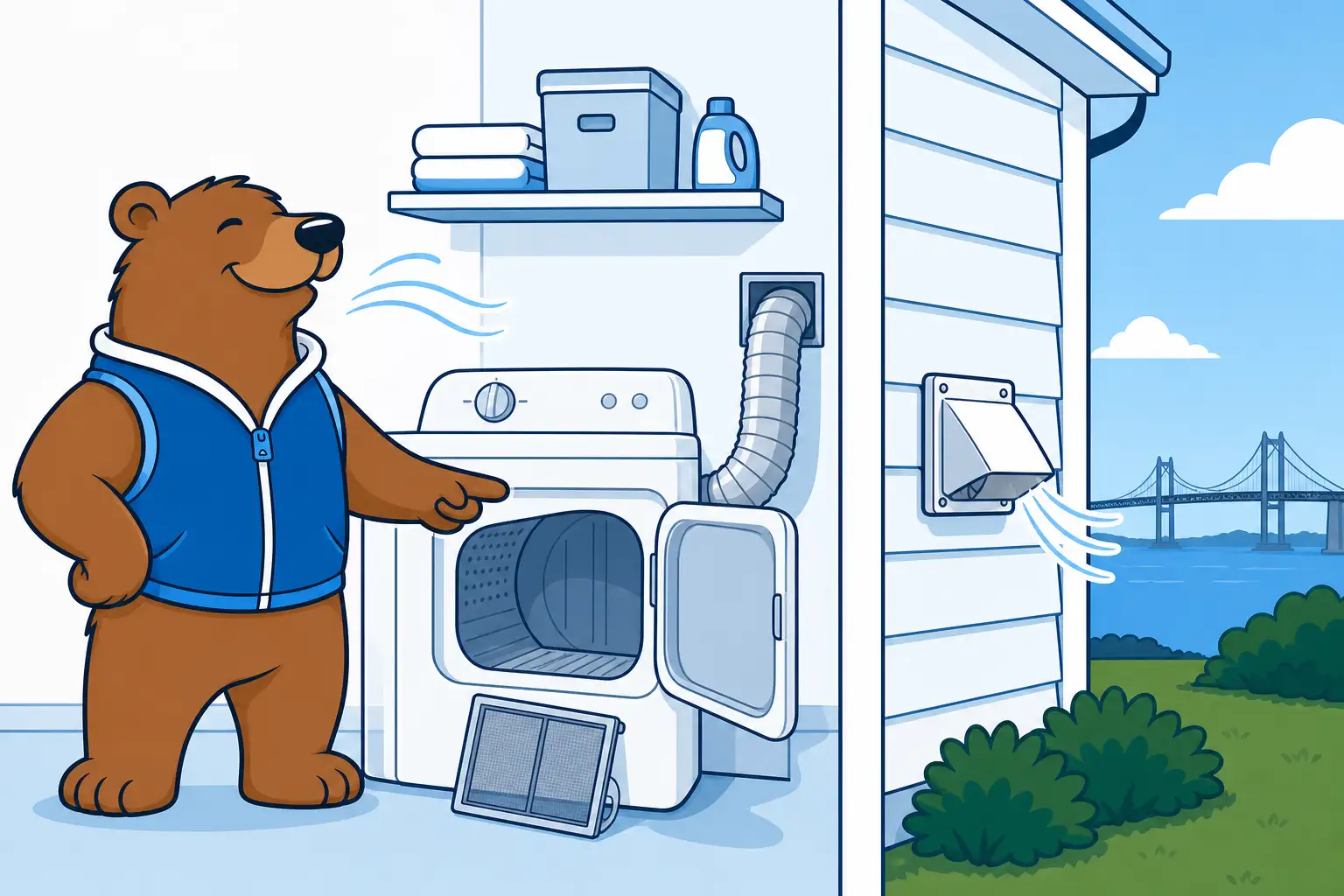
Dryer Vent Cleaning vs Lint Trap: What's the Difference?
The lint trap is only the removable screen. The dryer vent is the hidden exhaust path. Here is where each cleaning stops, what we clean, and when to schedule service.