Air Duct Cleaning Cost Long Island (2026)
The Short Answer
On Long Island, air duct cleaning usually costs $196 to $650 for many whole-home jobs, based on our completed 2026 jobs, with $400 as a strong middle anchor. Our $97 basic whole-home cleaning covers entry-level service, but the final quote changes with system count, vents and returns, buildup, access, and optional add-ons.
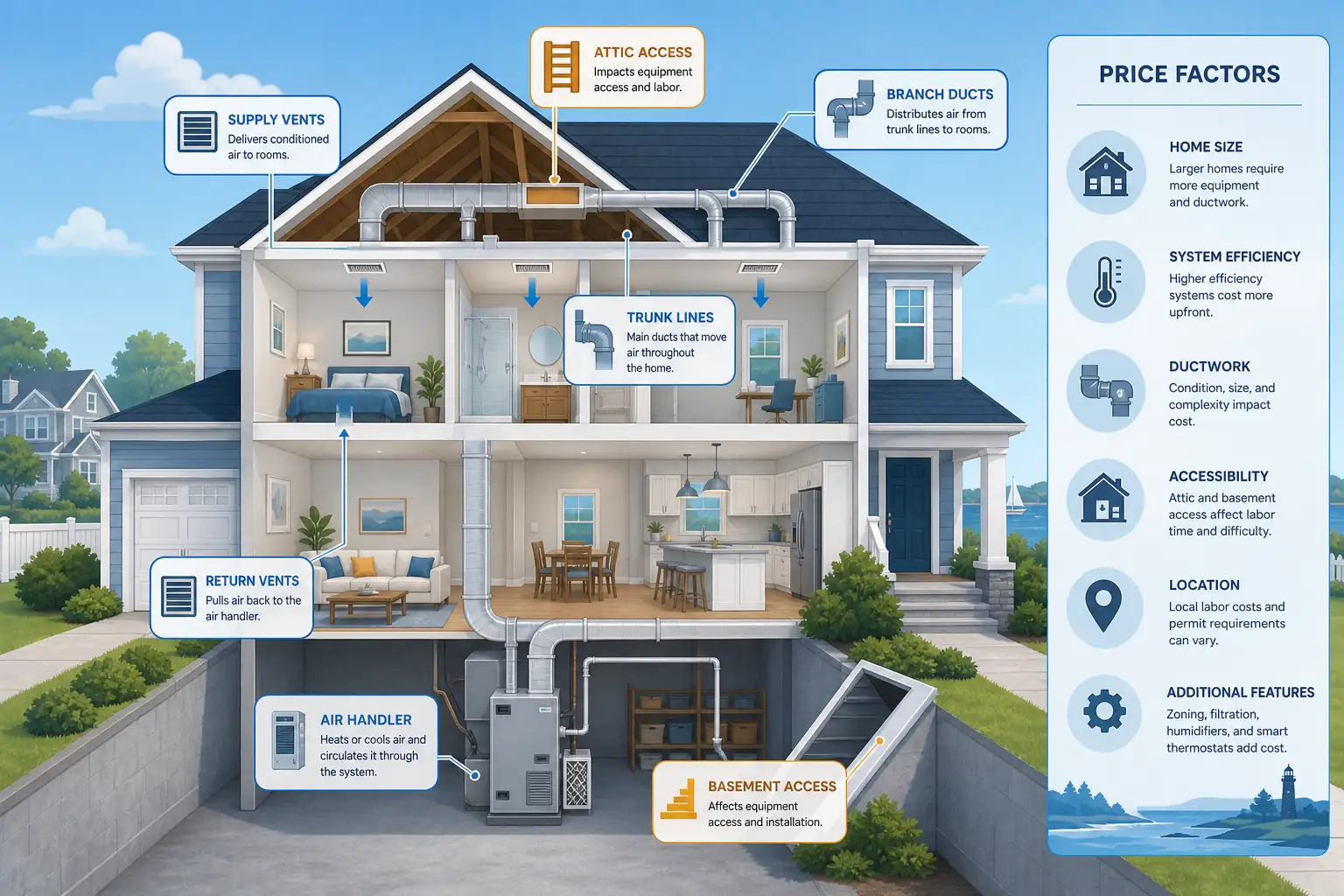
The air duct cleaning cost Long Island homeowners ask us about depends on what your HVAC system actually needs, not just a coupon price. Our crews price the job around the number of systems, supply ducts, return ducts, trunk lines, branch ducts, access, and buildup. Clean ducts move more air and stop feeding built-up dust back through your registers and grilles.
Use this table as a planning guide before you compare quotes.
| Long Island home or HVAC setup | Real price anchor to compare | What usually moves the quote |
|---|---|---|
| Entry-level whole-home basic cleaning | $97 basic option | One accessible system, standard access, normal buildup, no added scope |
| Condo, co-op, compact ranch, or small AC-only duct setup | $196 to $400 planning range | Fewer vents, but building access, parking, elevator rules, and return count matter |
| Typical Cape, ranch, split-level, or colonial with one HVAC system | Around the $400 median | One air handler or furnace, supply and return network, normal dust inside ducts |
| Larger home or multi-zone system | $400 to $650 planning range | Extra air handlers, longer duct runs, attic or crawlspace access, more returns |
| Heavy-debris or post-renovation duct cleaning | Written range after inspection | Sheetrock dust, sawdust, debris in trunks, added containment, longer cleaning time |
These are planning anchors, not final fixed prices. In our larger 2026 air-duct pricing set, based on our completed jobs, the lower quartile was $196, the median was $400, and the upper quartile was $650 (n=135). A newer completed air-duct-only snapshot, also based on our completed jobs, showed a $295 median and a middle half of $100 to $570 (n=33), which is why we inspect the system before locking in scope.
How much does air duct cleaning cost on Long Island in 2026?
Most Long Island homeowners should use $196 to $650 as a realistic planning range, with $400 as the midpoint from our larger 2026 completed-job set. The advertised $97 basic cleaning is real for entry-level whole-home work, but homes with extra air handlers, heavy debris, difficult access, or optional add-ons need a wider written quote.
A good duct-cleaning quote starts with the HVAC system, not just square footage. A 1,500-square-foot Cape with one easy basement air handler prices differently from a 1,500-square-foot home with an attic air handler, long flex duct, and tight access.
The EPA does not recommend duct cleaning on a fixed timer. Its air duct cleaning guidance points homeowners toward condition-based cleaning, such as visible mold, pests, or excessive debris. We follow that same logic: inspect first, clean when the ductwork shows it needs cleaning.
When cleaning is needed, our air duct cleaning service removes built-up dust, lint, loose debris, and airflow-blocking material from the duct system. Your vents stop feeding that buildup back into the rooms, and clean ducts move more air through the registers.
What should be included in a standard duct cleaning price?
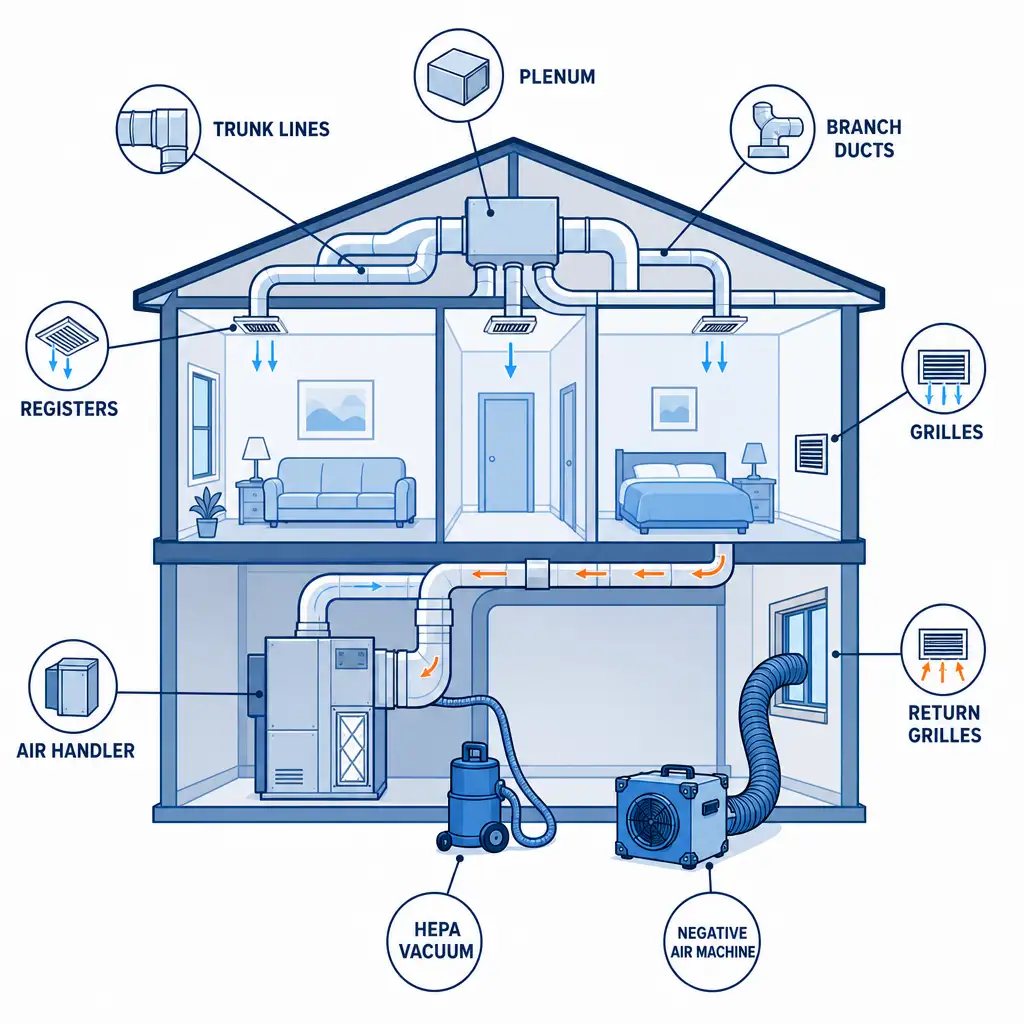
A standard price should cover the duct system being cleaned, not just the visible vent covers. For a normal whole-home appointment, we expect the quote to spell out supply ducts, return ducts, accessible trunk lines, branch ducts, registers, grilles, the plenum area, and the air handler or furnace access point tied to that system.
Here is the plain-English checklist we want homeowners to look for:
- Supply vents and registers are counted and cleaned.
- Return grilles and return ducts are included, not treated as surprise extras.
- Accessible trunk lines and branch ducts are part of the scope.
- The plenum and main duct connections are inspected where reachable.
- A negative air machine or HEPA vacuum is used to pull loosened debris out of the system.
- Rotary brush or air whip agitation is used where the duct material allows it.
- The crew explains whether the blower compartment, air handler cabinet, evaporator coil access, or furnace interior is included or separate.
Some low-price offers only include vent covers and a short section behind each register. That is not the same as cleaning the duct system. If trunk lines and returns are excluded, dust remains in the main air pathways and keeps moving through the home.
If you want a step-by-step breakdown, our professional duct-cleaning process guide explains how negative pressure, agitation tools, registers, returns, and main duct runs fit together.
Are hidden fees different from fair site-specific charges?
Hidden fees are charges not explained before booking; fair site-specific charges are documented line items for real extra labor, systems, or access. A low ad becomes a bait-and-switch when the crew arrives, redefines basic cleaning, and pressures you to buy mandatory upgrades that should have been discussed before the appointment.
A teaser ad around $99 is not automatically bad. Our $97 basic is an entry-level whole-home option. The problem starts when a coupon does not say whether it includes returns, trunk lines, extra air handlers, attic access, crawlspace access, or a real debris-removal setup.
Reasonable charges include:
- Extra HVAC systems or multi-zone systems.
- Extra returns, oversized returns, or unusual duct layouts.
- Heavy debris from renovations, pests, or long-term neglect.
- Tight attic air handler access, crawlspace access, or finished basement access.
- Optional sanitizer, deodorizer, blower compartment cleaning, or coil-related work.
Red flags include:
- A price that sounds whole-house, but excludes most of the ductwork.
- A refusal to list supply ducts, return ducts, and trunk lines in writing.
- A crew that makes sanitizer mandatory on every job.
- A quote that changes before anyone opens a vent or inspects the air handler.
- Pressure to approve add-ons immediately without showing the condition.
If a duct-cleaning ad turns into a pressure sale, Long Island homeowners have local consumer resources, including the Nassau County Office of Consumer Affairs and the Suffolk County Department of Labor, Licensing & Consumer Affairs. We would rather put the scope in writing before work starts, so you can compare the offer calmly.
Why don't Long Island homes all cost the same to clean?
Long Island pricing varies because many homes were expanded, retrofitted, or zoned over time. A small Cape in the Town of Hempstead, a split-level in the Town of Oyster Bay, and a larger colonial in the Town of Brookhaven may all have different duct routes, air-handler locations, returns, and access points.
In Nassau County, we often see older capes, ranches, splits, and colonials in the Town of Hempstead, Town of Oyster Bay, and Town of North Hempstead. Some have sheet metal ductwork in a basement. Others have central AC retrofitted into an attic, with flex duct serving second-floor rooms.
In Suffolk County, homes in the Town of Huntington, Town of Brookhaven, Town of Islip, Town of Babylon, and Town of Smithtown often include larger layouts, additions, separate zones, or longer duct runs. A multi-zone system means more than one air handler or furnace path, which changes the labor and equipment setup.
Finished basements also matter. If trunk lines are exposed, our crews reach and clean them faster. If the basement is finished and access panels are limited, we slow down, protect the space, and work through the available openings.
Condos and co-ops can price lower when the system is small, but access rules change the job. Parking, elevator times, building management approval, service entrances, and insurance paperwork matter in Nassau County, Queens, and Brooklyn buildings. A smaller system is not always a simpler appointment.
Crawlspace access is another price driver. Tight, dusty, or low-clearance spaces take more setup and more care. If the air handler is in an attic, temperature, flooring, ladder access, and duct condition all affect the quote.
Is per-vent, per-system, or whole-house pricing fairest?
The fairest pricing model is the one that matches the way the HVAC system is built and lists what is included. Whole-house pricing is easiest for simple one-system homes. Per-system pricing is clearer for multiple air handlers. Per-vent pricing only works if returns, trunk lines, and access are counted up front.
Per-vent pricing looks simple, but it can hide the parts that matter most. A home with 12 supply registers and 3 large returns is not the same as a home with 12 supplies and 1 small return. Returns carry a lot of household dust back toward the air handler, so they belong in the estimate.
Per-system pricing works well for homes with separate upstairs and downstairs equipment. If you have two air handlers, two plenums, and two duct networks, the quote should say that clearly. A multi-zone home is not a one-system home just because it has one street address.
Whole-house pricing is easy to compare when the offer defines whole-house. Ask if the price includes supply ducts, return ducts, branch ducts, trunk lines, registers, grilles, and the accessible air handler or furnace connection.
If you live in Nassau County and want a deeper town-by-town pricing discussion, use our Nassau County duct-cleaning cost guide as a companion. This island-wide guide is built for comparing Nassau County and Suffolk County layouts side by side.
Which optional add-ons are worth paying extra for?
Legitimate add-ons are optional, explained before work, and tied to a condition we can show you. Sanitizer, deodorizer, blower compartment cleaning, evaporator coil access, dryer vent cleaning, and post-renovation dust removal should not be treated as automatic fees. They make sense only when the inspection shows the need or the homeowner asks for that scope.
Sanitizer is not a substitute for debris removal. We pull the dust and debris out first. If sanitizer is appropriate, it should be named, priced, and explained before it is applied.
Deodorizer is also optional. If the odor source is in the ductwork, cleaning removes the material that is holding that smell. If the source is a dead rodent, moisture problem, pet area, or HVAC drain issue, deodorizer alone is the wrong answer.
Blower compartment and evaporator coil access are separate quote items in some homes because they are inside the air handler or furnace cabinet, not the duct runs themselves. A dirty blower wheel throws dust back into the clean side of the system. A dirty coil restricts airflow and belongs in an HVAC maintenance conversation when access and condition call for it.
Mold-related work needs careful language. If we see suspected mold, we document what we see and explain the next step. In New York, mold assessment and mold remediation are separate licensed services under New York State Department of Labor mold licensing rules. Standard duct cleaning is not the same as licensed mold remediation.
Dryer vent cleaning is a separate service, not part of air duct cleaning. Our dryer vent cleaning is $79. The NFPA says homeowners should clean the lint filter and keep the dryer exhaust vent clear in its clothes dryer safety guidance. With the lint gone, your dryer dries a full load in one cycle again, and the vent stops holding a fire's fuel supply.
Post-renovation duct cleaning is also different from a normal dusty-home cleaning. Sheetrock dust and sawdust spread into return cavities, branch ducts, and trunk lines. For renovation-specific scope, see our post-renovation duct cleaning guide.
Move-in cleaning is another case where the condition of the ductwork should lead the decision. If you open the returns and see construction dust, pet hair, old debris, or signs that the prior owner did not maintain the HVAC system, inspect the ducts before you run the system through the whole house.
We do not promise allergy relief, asthma improvement, or illness prevention from duct cleaning. We remove the dust, lint, and debris inside the duct system. If your concern is medical, it is smart to discuss symptoms with a qualified health professional.
What should you ask before accepting an air duct cleaning quote?
Before you accept a quote, ask questions that force the scope into plain English. The goal is not to find the lowest number on a screen. The goal is to know which HVAC system is included, how many vents and returns are counted, what equipment will be used, and which items are optional.
Use this script before you book:
- Is this quote whole-house, per-system, or per-vent?
- How many supply registers and return grilles are included?
- Are return ducts, trunk lines, branch ducts, and the plenum included?
- Does the quote include the air handler or furnace access point?
- Is the blower compartment included, optional, or separate?
- Is evaporator coil access included, or is that an HVAC maintenance item?
- What happens if the crew sees suspected mold?
- Are sanitizer and deodorizer optional?
- What changes the price on site?
- Will I get the final scope in writing before I approve the work?
NADCA-style terminology is useful because it pushes the conversation toward the full HVAC system, not just vents. Still, a trade term does not replace a written scope. Your estimate should name the system, the included duct sections, the equipment used, the exclusions, and the add-ons you accepted.
For timing, a typical one-system duct cleaning should be treated as a single service appointment, not a quick vent-cover wipe. Multiple air handlers, tight attic access, finished basement access, heavy post-renovation dust, or suspected contamination extend the visit because our technicians have more duct sections to open, agitate, and vacuum.
We do verify scheduling from our job data. In 331 analyzed jobs as of 2026-07-14, the median booking-to-visit lead time was 4 days and the average was 5.5 days, based on our completed scheduling data.
That same scheduling data included 22 same-day visits and 46 next-day visits. Arrival windows are 3 hours, and the 8:00 to 11:00 AM window is the most requested. You can call 631-900-2634 from 8 AM to 7 PM ET, or schedule a written quote online any time.
What is the bottom line for Long Island homeowners comparing duct cleaning prices?
Use the $196 to $650 range as your first reality check, then compare the scope line by line. The fairest quote identifies the HVAC system, returns, trunk lines, vents, access, equipment, exclusions, and optional add-ons. If a coupon skips those details, it is not ready for approval.
A clean price is not always the cheapest number. It is the number that matches the actual system in your home. When our technicians clean the ductwork, we remove the buildup that has been sitting inside the air paths, and the registers stop blowing that stored dust back into the rooms.
If your system is clean, we tell you. If it needs cleaning, we show you where the buildup is and price the job around the real work, not a surprise script at the door.
Frequently Asked Questions
A finished basement often hides the main trunk lines behind drywall, ceilings, or tight access panels. That changes how our technicians reach the duct system, protect the room, and set up the negative air equipment. Exposed basement ductwork is faster to inspect and clean. Finished access does not make cleaning impossible, but it belongs in the quote.
Written by
MikeField Technician
Mike is a field technician at FreshBear. He cleans dryer vents, air ducts, and chimneys in Long Island homes, so the guides under his name come from the jobs he runs: what a vent line actually looks like when it comes apart, and what he finds behind the dryer. Everything published under his byline is checked against that first-hand experience.
Keep Reading
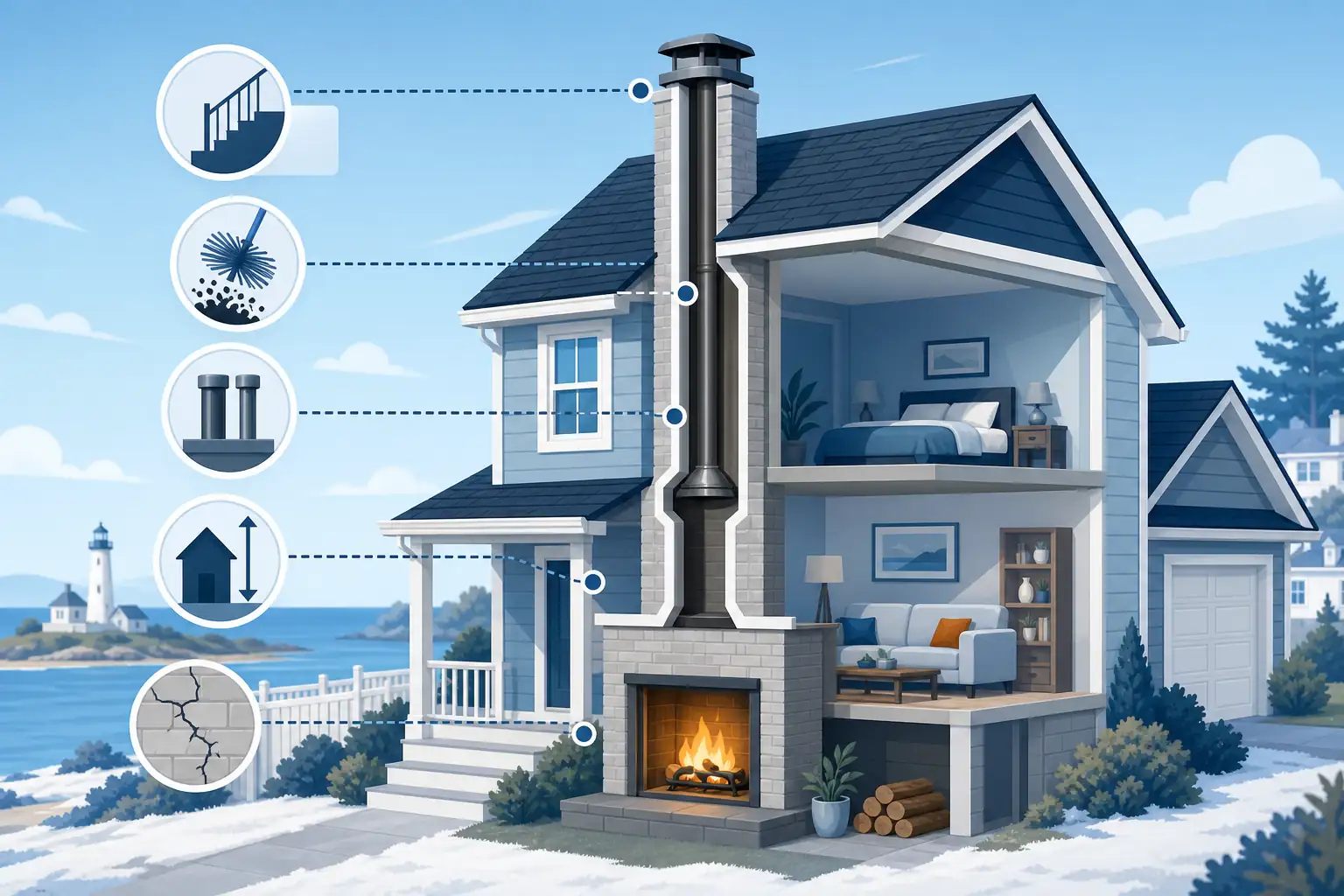
Chimney Sweep Cost Long Island: Price Guide
A practical Long Island chimney sweep cost guide explaining why we inspect first, what affects the quote, how to avoid hidden fees, and how to book a written estimate.
Air Duct Cleaning Cost Nassau County Guide
See what air duct cleaning costs in Nassau County, what our $97 basic offer covers, and which local home factors can move the final price.